

Government Correspondence Management: Bringing Official Communication into One Structured Workflow
- Menna
- November 19, 2026
- Government Services, Use Case
- 0 Comments
Government entities handle a continuous flow of incoming and outgoing correspondence. Official letters must be registered, reviewed, classified, assigned to the right departments, approved, answered, and archived. When these activities are managed across paper documents, email exchanges, and separate tracking methods, maintaining visibility and accountability throughout the correspondence lifecycle becomes a challenge.
For a government entity seeking to improve how official communication is managed, the objective was to establish a centralized digital process that connects document registration, internal routing, approvals, response tracking, and electronic archiving.
The Challenge: Managing the Full Lifecycle of Official Correspondence
The correspondence process involves more than receiving and sending letters. Each document may pass through multiple departments and responsible employees before the required action is completed.
Without a connected process, teams can face difficulties such as:
- Tracking the current status and location of official letters.
- Identifying the department or employee responsible for the next action.
- Managing incoming and outgoing correspondence with consistent reference numbers.
- Following up on pending responses and approaching deadlines.
- Retrieving previous correspondence and reviewing its action history.
- Maintaining controlled access and traceability across departments.
The requirement was therefore to move beyond document storage and establish a structured correspondence management process.
The Solution: A Digital Correspondence Management Application Built with Aura
Using Aura, the proposed solution was structured around the complete lifecycle of government correspondence, connecting document records with the workflows, responsibilities, and follow-up activities associated with each letter.
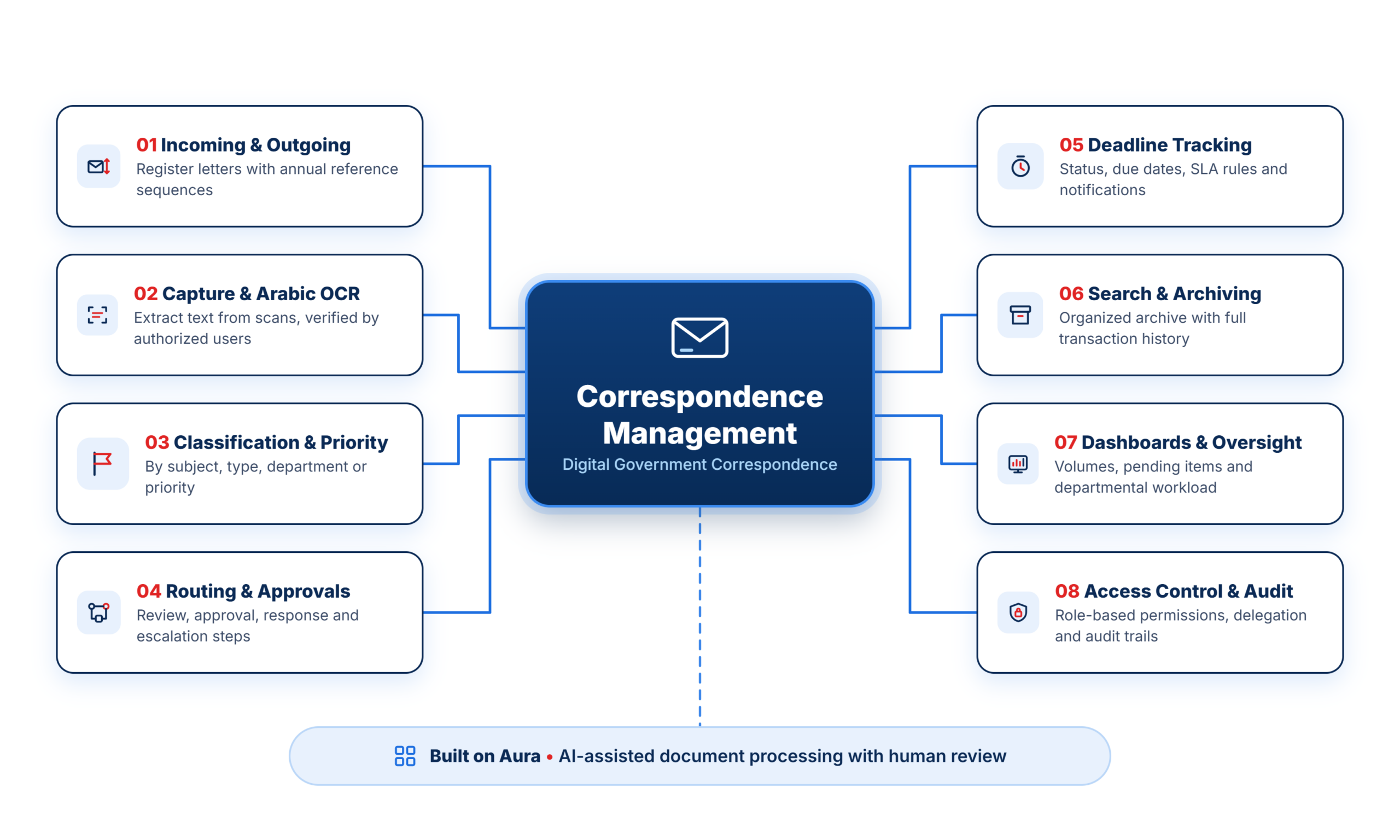
The solution design covered the following capabilities:
1. Centralized Registration of Incoming and Outgoing Letters
Dedicated processes were defined for incoming and outgoing correspondence, with separate annual reference sequences where required. Each record maintains its essential details and associated documents, creating a consistent reference point throughout its lifecycle.
2. Digital Document Capture and Information Extraction
Users can upload scanned documents or photographs of official letters. Arabic OCR supports the extraction of document text and relevant information, reducing the need for manual re-entry. Extracted information remains subject to review and correction by authorized employees before being confirmed.
3. Structured Classification and Routing
Correspondence can be classified by type, subject, department, and priority. Once registered, the letter can be routed to the relevant department or responsible employee based on the entity’s defined procedures.
4. Automated Review and Approval Workflows
The application connects correspondence records to configurable workflows for internal review, assignment, approval, and response. Responsibilities and approval steps can be defined according to the organization’s administrative structure.
5. Response Management and Deadline Monitoring
Each correspondence record can be followed through its processing stages, with assigned responsibilities, due dates, and pending actions visible to relevant users. SLA rules, notifications, and escalation mechanisms help bring delayed or overdue items to attention.
6. Searchable Electronic Archive
The solution brings correspondence records and their related documents into an organized electronic archive. Authorized employees can retrieve previous letters and review the history of actions taken, supporting continuity and easier reference.
7. Operational Dashboards and Management Visibility
Dashboards provide an overview of correspondence volumes, processing statuses, pending items, and departmental workloads. This gives management a clearer view of operational activity and areas requiring follow-up.
8. Controlled Access and Auditability
Role-based permissions, delegation rules, and audit trails support controlled access to official correspondence and help maintain a traceable record of actions performed throughout the process.
How the Correspondence Workflow Works
The designed process connects the main stages of correspondence management into one continuous workflow:
- Receive and register: An employee records an incoming letter or creates an outgoing correspondence record.
- Capture and classify: The document is uploaded, relevant information is extracted where applicable, and its classification is reviewed.
- Route for action: The correspondence is assigned to the relevant department or responsible employee.
- Review and approve: The letter moves through the required review and approval steps.
- Respond and follow up: The responsible team prepares the response, while deadlines and pending actions remain trackable.
- Close and archive: The completed correspondence and its related documents are retained in the electronic archive for future retrieval.
The Role of Aura in Government Correspondence Management
Aura provides the application-building and workflow capabilities needed to bring these activities together in a connected digital environment.
Beyond structuring correspondence records and approval processes, Aura’s AI capabilities can support document intelligence through OCR and information extraction, while AI-powered workflows can assist with processing activities. Business rules, permissions, and human review can be configured around the entity’s administrative requirements.
The result is a solution design that connects official documents, people, and processes, helping government teams manage correspondence with clearer responsibilities, better operational visibility, and a more structured approach to follow-up.
Explore Aura to discover how enterprise applications, intelligent workflows, and AI capabilities can support the digital transformation of government operations.