
Success Story: Automating Regulatory Requests Through Integrated Banking Workflows
- Menna
- November 11, 2026
- Banking & Finance, Success Story
- 0 Comments
The Challenge: One Regulatory Request, Multiple Banking Systems
Financial institutions receive regulatory requests and inquiries that require access to customer information, account records, and operational data distributed across multiple enterprise systems.
Processing a single inquiry may involve retrieving customer details from a Master Data Management (MDM) platform, accessing account information through Core Wallet Management, and obtaining additional records from Customer Relationship Management (CRM) and other connected applications.
Although these systems provide the required information, completing a regulatory request involves more than exchanging data through APIs. Each transaction must follow the appropriate process, trigger actions across relevant systems, handle integration failures, and return a response within defined Service Level Agreements (SLAs).
The complexity increases when a connected service becomes unavailable or when an inquiry requires manual intervention. Operations teams need to investigate the issue, resume processing, and maintain visibility over the transaction without losing the work already completed.
The objective was to establish a centralized workflow and integration layer capable of managing regulatory requests from initial reception to final response, while connecting existing banking applications and supporting operational monitoring.
The Solution: A Unified Integration and Workflow Automation Layer
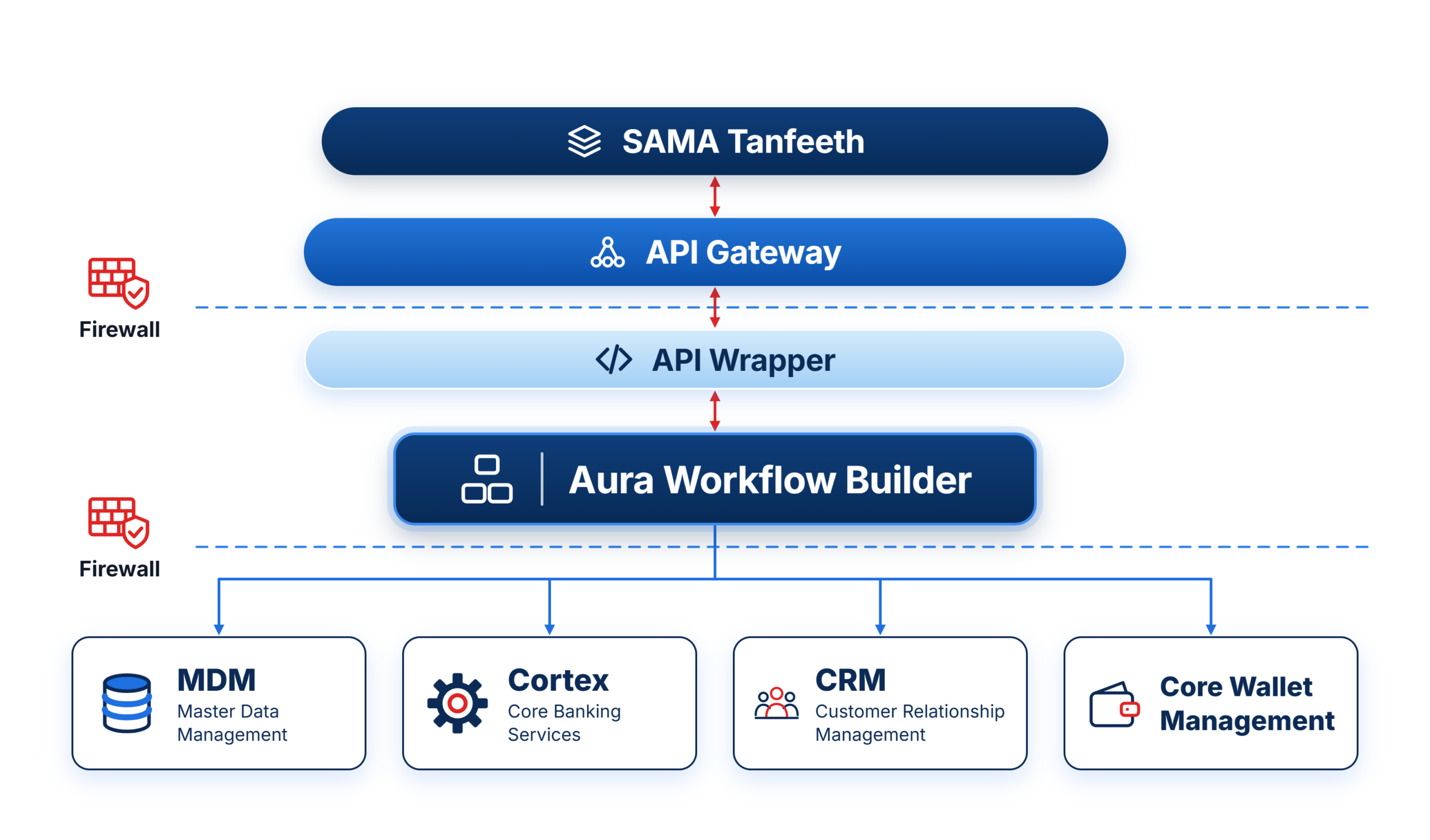
Aura successfully delivered an enterprise workflow automation and integration solution supporting SAMA Tanfeeth, the regulatory request processing initiative of the Saudi Central Bank.
The implementation established a centralized execution layer between the regulatory API management environment and the financial institution’s internal systems, enabling requests and inquiries to be processed through coordinated workflows.
Rather than handling each API interaction independently, the platform manages the complete transaction lifecycle. Each request is received, acknowledged, registered, and routed to the appropriate workflow. The system then connects to the required internal applications, retrieves information or triggers actions, and coordinates the response through the API management layer.
The implementation integrated four core enterprise systems:
- Master Data Management (MDM): Customer and reference data management.
- Core Wallet Management: Wallet and account-related services.
- Customer Relationship Management (CRM): Customer information and related records.
- Cortex: Connected enterprise services required for transaction processing.
This approach enabled the institution to coordinate activities across existing applications through a centralized workflow platform without replacing its underlying systems.
How the Regulatory Request Processing Workflow Operates
1. Receiving and Acknowledging Regulatory Requests
The process begins when a regulatory request reaches the institution through its API management environment. The platform receives an asynchronous SOAP API request, sends an acknowledgment, and saves the received information in the corresponding transaction screen.
For example, a customer account inquiry is registered in a dedicated inquiry screen, where its information becomes available for processing and monitoring.
2. Triggering the Appropriate Workflow
Once the request is registered, the platform triggers the workflow associated with the requested service. Depending on the inquiry type, the workflow retrieves the required information or initiates actions across one or more connected systems.
This allows regulatory transactions to follow defined processing steps rather than relying on separate manual interactions between applications.
3. Executing Cross-System Integrations
The workflow communicates with the connected enterprise applications, including MDM, Core Wallet Management, CRM, and Cortex. Through these integrations, the platform coordinates the information exchange and actions required to process the inquiry.
API requests and responses are recorded, providing visibility into the integration activities associated with each transaction.
4. Handling Integration Failures and Operational Exceptions
Exception handling was a central requirement of the implementation. If an integrated service fails during processing, the platform automatically creates an investigation task and assigns it to the responsible user.
The assigned user can investigate the issue and determine how the transaction should continue.
Once the problem is resolved, the platform allows the user to retry execution from the point of failure, rather than restarting the entire workflow. Where the process permits, the user can also continue manually and instruct the system to skip to the final action.
This provides operations teams with a structured mechanism for managing interrupted transactions.
5. Managing Human Tasks and SLA Monitoring
Certain regulatory services require manual processing or intervention by authorized personnel. When a service is designated as manual, the workflow assigns a task to the appropriate user and sends an assignment notification.
User delegation is also configurable within the workflow. In parallel, SLA rules monitor processing activities and generate alerts when required.
These capabilities support the coordination of automated and manual tasks within a single process.
6. Returning the Regulatory Response
Once the required processing steps are completed, the platform sends the response through the API management layer, which communicates the result to the regulatory interface.
The transaction’s processing information, integration activities, and associated logs remain available for operational monitoring.
Centralized Transaction Monitoring and Operational Visibility
Beyond executing regulatory workflows, the solution provides dashboards for transaction monitoring. The implementation includes separate monitoring capabilities for the regulatory interface and the institution’s operations team.
These dashboards enable authorized users to track transactions and allow operations personnel to take action on running transactions when intervention is required.
Combined with SLA monitoring, task assignments, and integration logging, this gives operations teams a centralized view of transaction processing and outstanding issues.
Technical Implementation Highlights
The project addressed several technical requirements associated with enterprise banking integration.
Asynchronous API Processing: The solution supports asynchronous SOAP-based requests, allowing incoming inquiries to be acknowledged before the related workflow completes its processing.
Secure Web Service Integration: The technical implementation included support for mutual Transport Layer Security (mTLS) to secure inbound and outbound web service integrations.
Flexible REST and SOAP Integration: An HTTP listener capability was introduced to support inbound integrations using REST or SOAP, according to the structure defined by the calling system.
Transaction and Integration Logging: The solution includes logging mechanisms for inbound and outbound web service requests and responses, alongside system and transaction audit logs.
OpenShift Deployment: The implementation included deployment on OpenShift as part of the enterprise technical environment.
Transaction Load Testing: Stress testing was conducted to support a processing load of five transactions per second, with the objective of maintaining response-time performance under the tested load.
The Business Value
The completed implementation established a centralized approach to processing regulatory requests across multiple banking applications. By combining system integration, workflow automation, human task management, and operational monitoring, the solution delivered several important capabilities:
Centralized request processing: Regulatory inquiries are received, registered, processed, and responded to through a coordinated workflow.
Cross-system execution: The platform manages interactions between connected enterprise applications without requiring their replacement.
Structured exception handling: Integration failures generate investigation tasks, enabling operations teams to resolve issues and resume processing from the point of failure.
Automated and manual task coordination: Workflows support both system-driven activities and tasks requiring human intervention.
Transaction visibility: Operational dashboards, SLA monitoring, and integration logs provide information about transaction status and processing activities.
Technical integration flexibility: The architecture supports enterprise API communication, including REST and SOAP integrations.
These capabilities demonstrate how workflow automation can address operational complexity in environments where transactions span multiple systems.
From System Connectivity to End-to-End Process Automation
Connecting banking applications through APIs is an essential part of digital transformation, but integration alone does not manage the complete business process.
This implementation demonstrates how an enterprise workflow platform can coordinate regulatory requests, execute actions across connected systems, manage exceptions, and maintain operational visibility throughout the transaction lifecycle.
Rather than treating each integration as an isolated activity, the solution brings the different processing stages together within one managed workflow.
The result is a unified approach to handling regulatory transactions across existing enterprise applications.
Beyond Workflow Automation: Introducing Aura’s AI Capabilities
Building on enterprise application and workflow automation, Aura extends these capabilities with AI-powered app development, intelligent workflows, AI agents, document intelligence, and operational analytics.
Organizations can use Aura AI Builder to accelerate enterprise application development, embed AI-powered tasks and agents into business workflows, and leverage AI Analyzer to extract insights from operational information.
Combined with enterprise integrations, configurable approvals, permissions, and audit trails, Aura helps organizations move beyond traditional process automation toward more intelligent and controlled execution.
Explore Aura — Enterprise AI Execution Platform