
Human Capital Intelligence: Turning Employee Records into Workforce Insights
- Menna
- November 19, 2026
- Government Services, Use Case
- 0 Comments
Government organizations maintain extensive employee information, including personal records, qualifications, professional experience, certificates, and employment history. However, having employee data does not automatically provide the insight needed to understand workforce capabilities, identify skills, or support informed human capital planning.
When information is spread across employee files, CVs, certificates, and spreadsheets, HR teams may spend considerable time collecting and reviewing records before they can answer important workforce questions.
A Human Capital Intelligence solution built with Aura brings employee information together, helping transform scattered records into structured, reviewable data that supports workforce analysis and more informed HR decisions.
The Challenge: Moving from Employee Records to Workforce Intelligence
The challenge was to bridge the gap between maintaining employee records and making that information useful for workforce analysis.
Key requirements included:
- Bringing employee information from different sources into a structured view.
- Extracting relevant information from CVs and certificates.
- Maintaining traceability between extracted information and its source documents.
- Reviewing and validating extracted employee data.
- Analyzing workforce information to identify skills and qualifications.
- Supporting evidence-based shortlisting against defined requirements.
The objective was to make employee information easier to organize, review, and analyze, helping HR teams move beyond manual record assessment toward more informed workforce insights.
The Solution: A Human Capital Intelligence Application Built with Aura
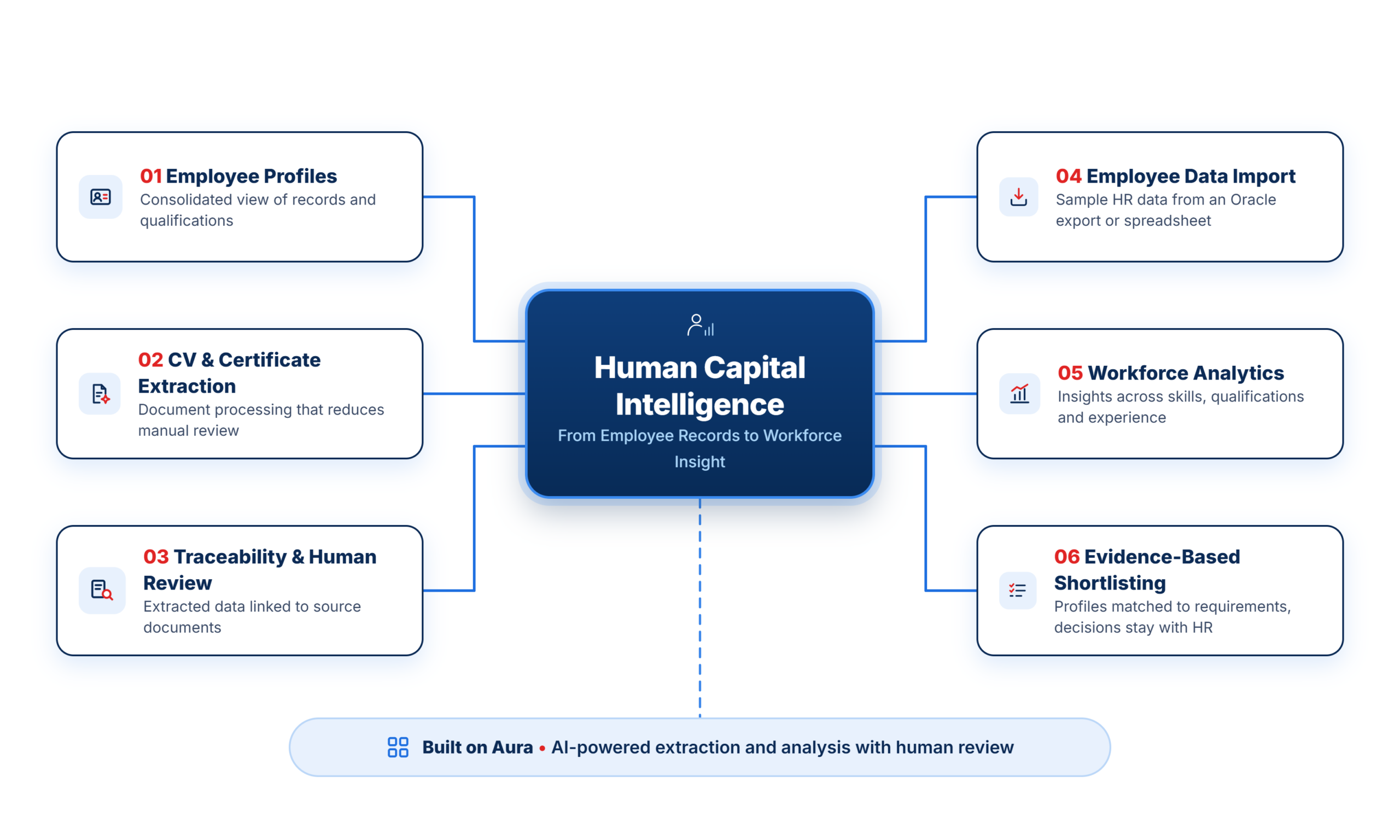
Using Aura, the solution brings together employee information, document processing, data validation, and workforce analysis through a connected digital application.
1. Consolidated Employee Profiles
Employee information is organized into structured profiles, providing a consolidated view of relevant workforce records, qualifications, and professional experience.
2. CV and Certificate Information Extraction
AI-powered document processing supports the extraction of relevant information from CVs and certificates, reducing the manual effort involved in reviewing employee documents and entering data.
3. Source Traceability and Human Review
Extracted information remains linked to its source document, allowing HR users to review and validate details before relying on them. This maintains transparency between original employee records and the structured information used for analysis.
4. Employee Data Import
The solution supports incorporating employee information from existing data sources, including Oracle data exports and spreadsheets. This helps bring existing HR records into a structured environment for further processing and analysis.
5. Workforce Analytics and Insights
Once employee information is structured, workforce data can be analyzed across qualifications, experience, and skills. This helps HR teams explore the capabilities represented across their employee records and identify relevant workforce insights.
6. Evidence-Based Candidate Shortlisting
Employee profiles can be compared against defined requirements to support candidate shortlisting. Relevant qualifications, skills, and experience provide supporting evidence for HR review, while final assessments and decisions remain with authorized personnel.
How the Human Capital Intelligence Process Works
The solution connects employee data, document intelligence, and workforce analysis through a structured process:
- Import employee data: Employee records are brought into the application from available data sources, such as Oracle exports or spreadsheets.
- Process documents: CVs and certificates are submitted for information extraction.
- Structure employee profiles: Relevant details are organized into employee records.
- Validate extracted information: HR users review the extracted details against their original source documents.
- Analyze workforce capabilities: Structured records are used to explore employee skills, qualifications, and experience.
- Support shortlisting: Employee information can be compared against defined requirements to assist HR evaluation.
The Role of Aura in Human Capital Intelligence
Aura provides the application-building and AI capabilities needed to connect employee records, document intelligence, data processing, and workforce analysis within one digital environment.
AI-powered document processing helps extract information from CVs and certificates, while AI analysis supports the organization and interpretation of workforce data. These capabilities help HR teams work with employee information more efficiently while retaining human oversight over data validation and employment-related decisions.
By turning scattered employee information into structured, reviewable data, the solution demonstrates how Aura can help organizations gain better visibility into workforce capabilities and support a more informed approach to human capital management.
Explore Aura to discover how enterprise applications and AI capabilities can help organizations turn operational data into actionable insights.