

Whistleblowing Management: Bringing Confidential Reporting and Investigations into One Governed Workflow
- Menna
- November 26, 2026
- Government Services, Use Case
- 0 Comments
Organizations need a trusted way for employees and other stakeholders to report misconduct, fraud, policy violations, and unethical behaviour. However, when reporting channels, case assessments, investigations, evidence, and follow-up actions are managed across disconnected processes, maintaining confidentiality and ensuring consistent handling becomes difficult.
A centralized Whistleblowing Management System built with Aura brings the reporting and investigation lifecycle into one structured environment, helping organizations strengthen accountability, maintain oversight, and manage cases through clearly defined workflows.
The Challenge
Whistleblowing processes often involve multiple stakeholders, sensitive information, and several stages of review and investigation. When these activities rely on manual coordination or partially digital processes, organizations may face:
- Fragmented reporting channels and inconsistent case registration.
- Delays in reviewing reports, assessing allegations, and assigning investigations.
- Limited visibility into case progress, responsibilities, and outstanding actions.
- Challenges maintaining impartiality when conflicts of interest arise.
- Inconsistent evidence management, documentation, and investigation reporting.
- Limited consolidated oversight for management and governance committees.
The challenge is not simply receiving reports. It is ensuring that every report follows an accountable process from initial submission through assessment, investigation, and resolution.
The Solution: A Whistleblowing Management System Built with Aura
The solution brings the whistleblowing lifecycle into a centralized digital environment, connecting report intake, case assessment, investigation management, communication, recommendations, and governance reporting.
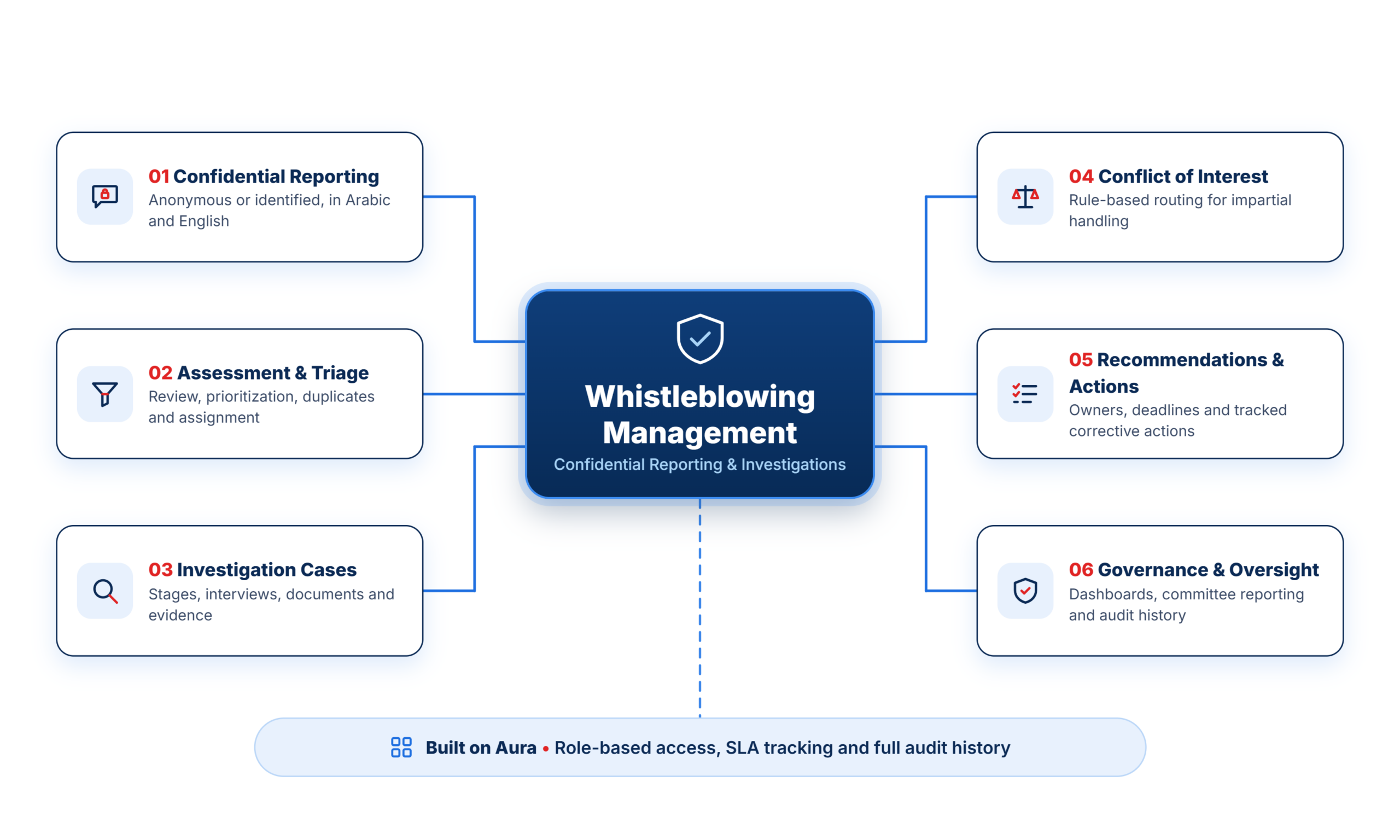
Key Capabilities
1. Confidential Report Submission
- Supports both anonymous and identified reporting.
- Provides Arabic and English reporting options.
- Organizes submissions through a structured reporting form and defined allegation categories.
- Enables anonymous reporters to follow up using a unique reference number and PIN.
- Supports secure two-way communication throughout the process.
2. Report Assessment and Case Triage
- Routes new reports through defined review and approval stages.
- Supports assessment, prioritization, and assignment based on established business rules.
- Identifies potential duplicate reports and preliminary conflicts of interest.
- Enables authorized reviewers to approve, return, dismiss, or progress reports according to their responsibilities.
3. Investigation Case Management
- Converts approved reports into structured investigation cases.
- Assigns cases to the appropriate investigation or supporting teams.
- Tracks investigation stages, responsibilities, and case timelines.
- Supports investigation planning, interviews, document reviews, and evidence management.
4. Conflict-of-Interest Handling
- Applies defined routing rules when a potential conflict of interest is identified.
- Directs conflicted cases to the appropriate compliance function.
- Supports impartial case handling through controlled access and role-based responsibilities.
5. Recommendations and Corrective Actions
- Maintains a structured register of investigation recommendations.
- Classifies actions into control enhancement, disciplinary action, and corrective action.
- Assigns action owners and anticipated completion dates.
- Tracks progress, sends reminders, and supports review before closure.
6. Governance, Reporting and Oversight
- Provides management dashboards for case progress and operational monitoring.
- Supports reporting for relevant governance committees and oversight bodies.
- Tracks investigation timelines, recommendations, and outstanding actions.
- Maintains structured records and an audit history of system activities.
How the Workflow Works
- Report submission: A whistleblower submits a report anonymously or with their identity.
- Initial assessment: The report is reviewed, categorized, prioritized, and assessed by authorized personnel.
- Case assignment: Approved reports are converted into investigation cases and assigned to the relevant team.
- Investigation: Investigators carry out the required procedures, collect evidence, document findings, and communicate through the defined process.
- Review and decision: Investigation findings are reviewed, classified, and submitted through the required approval process.
- Recommendations and follow-up: Actions are assigned to responsible owners and monitored until closure.
- Governance oversight: Management and authorized committees access structured reports and dashboards to monitor the overall process.
The Role of Aura
Aura provides the application-building and workflow foundation for bringing complex, multi-stage business processes into one governed environment. Its capabilities support configurable forms, business rules, approvals, role-based access, SLA tracking, integrations, notifications, and operational reporting.
The documented whistleblowing scope focuses on digitizing the existing reporting and investigation processes. AI-assisted case summarization and related intelligence capabilities are identified as later-stage enhancements, rather than part of the current documented delivery.
With Aura, organizations can build structured applications that connect people, processes, and enterprise systems while maintaining clear accountability throughout execution.
Explore Aura: https://ntgapps.com/aura/